
The United Arab Emirates Ministry of Defence has announced that the air force and air defence forces have successfully intercepted a significant number of aerial threats following a large-scale Iranian attack that commenced on February 28.

Amid escalating tensions, Iranian Deputy Foreign Minister Saeed Khatibzadeh declares Iran's unwavering commitment to a 'heroic nationalist defence' against perceived American and Israeli aggression, vowing to resist what he calls an 'invasion' to the very end.

The diplomatic intervention follows various media reports which attributed comments to Iranian lawmaker Alaeddin Boroujerdi, suggesting that merchant vessels were being charged USD 2 million for safe passage through the "conflict-hit Hormuz."

'American stature has been reduced because they have not been able to achieve their aims.'
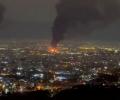
To be sure, Trump is furious, as the trajectory of the war is in a state of Zugzwang, as chess players call it. Trump and Netanyahu stare at two choices -- retreat in humiliation and concede Tehran's demands -- recognition of its rights, reparations, and binding security guarantees -- or perish in a quagmire, points out Ambassador M K Bhadrakumar.

Both sides have now revealed a preference for escalation over strategic defeat, and each new provocation narrows the space for the next pause. The Touska seizure, Iran's refusal to negotiate under blockade, Israel's strikes on Iranian oil infrastructure -- all of these add up to an increasingly untenable situation. This makes the wild card -- Trump and his motormouth -- more consequential than ever, notes Prem Panicker in his must read blog on the Iran War.

A senior government official confirms that Indian vessels do not require permission to navigate the Strait of Hormuz, despite regional tensions. Several Indian ships, including LPG tankers, have safely crossed the strait, ensuring continued supply of essential commodities to India.

External Affairs Minister S Jaishankar addressed the Rajya Sabha on India's position regarding the escalating conflict in West Asia, emphasising the need for peace, dialogue, and the safety of civilians, while also prioritising India's energy security and trade interests.

Far from it; the country's resistance to the US, its nuclear ambitions, and its pursuit of influence and proxies across the Middle East are driven by a constant search for independence and security. Thus, Iran will never capitulate. Trump will learn this home truth ultimately, and it is going to be a humbling personal experience that may even destroy his presidency, predicts Ambassador M K Bhadrakumar.

Egypt, Pakistan, Saudi Arabia and Turkey met in Islamabad in what analysts say is the formal opening of a new diplomatic formation that could reshape the post-war regional order. Their immediate goal is a ceasefire; their larger ambition is to ensure that neither Iran nor Israel emerges from this war in a dominant position. Pakistan's foreign minister then flew directly to Beijing and mooted a Chinese role as guarantor of any eventual agreement. Prem Panicker continues his must read daily blog on the Gulf War.

Iran has blamed the US for disruptions in oil and gas shipping through the Strait of Hormuz, citing 'destabilising actions' as the cause amid the ongoing West Asia conflict and rising energy prices.

Alliances fight wars effectively only when they share an endgame. If Israel acted without US knowledge, then the military alliance is operating without real coordination at the level of strategic targeting. Neither picture is reassuring in a war that is no longer regional in its consequences. Prem Panicker continues his must read daily blog on the Gulf War.

Former Maldives President Mohamed Nasheed advocates for building democratic institutions over military intervention in resolving international conflicts, particularly in the context of the escalating West Asia crisis. He also discusses the impact of the conflict on the Maldives' tourism-dependent economy and calls for a stronger, more understanding India in the Indian Ocean Region.

For weeks, the war skirted the edge of catastrophe without tipping over. Missiles flew, there was much destruction, commanders were assassinated, cities across the Gulf and even in Israel struggled to absorb the shock. But one line held: Energy infrastructure, the arteries of the global economy, remained largely untouched. That is no longer true. Prem Panicker continues his must read daily blog on the Gulf War.

The threat of wars hovers over the negotiations in Oman, but the good part is that Trump called the talks to be 'very good' and Iran's President Masoud Pezeshkian responded that they 'constitute a step forward', points out Ambassador M K Bhadrakumar.

'The next two to three weeks will not be decided in Washington.' 'They will be decided in Tehran, in whatever calculation Iran makes about the costs of continued resistance against the costs of appearing to have yielded.'

Indian refiners are negotiating for additional crude cargoes from the US, Russia, and West Africa to ensure adequate supplies amid Middle East tensions. Refineries are maintaining normal processing rates and deferring maintenance to build reserves. The move comes as conflict impacts tanker movements through the Strait of Hormuz, a key energy transit route.

The question is no longer whether the war will expand. It has. The next few days will tell us whether the war stabilises around Hormuz or whether the Strait itself becomes the trigger for a far larger rupture. What to watch for over the next 48 hours is simple: Any move by the US toward direct naval control of the Strait; any credible Iranian attempt to disrupt or mine shipping lanes and, critically, whether energy infrastructure in the Gulf continues to be targeted.If those lines are crossed in tandem, the war will no longer be containable within the region.

When missiles fly in this region, they are never just aimed at military targets.

The ceasefire is still technically holding, to the extent that no overt hostilities have been reported yet, but the rhetoric has hardened dangerously. The week ahead will also clarify whether the Islamabad failure was a negotiating tactic or whether Washington has genuinely locked itself into a position from which the only exits are climb-down, escalation, or the slow bleed of a new status quo that nobody chose and nobody controls. Prem Panicker continues his must read blog on the Iran War.

By all available indications, the White House drafted a face-saving note and handed it, ready-made, to Islamabad. Pakistani Prime Minister Shehbaz Sharif was supposed to then post it in the guise of a plea urging Trump to extend the deadline by two weeks 'to allow diplomacy to run its course'. Trump would then graciously accept Pakistan's 'request' and declare a ceasefire. Sharif dutifully posted the message on X. Except that he, or whoever was handling the account, forgot to delete the tell-tale first line visible in the edit history: 'Draft - Pakistan's PM Message on X'. Prem Panicker's must read blog on the Iran War.

As days turn into weeks and America loses more planes, as the destruction of trillions of dollars worth military assets piles up, and dead bodies of soldiers return in ever greater numbers in coffins, Trump will have to answer some very difficult questions to save his presidency, notes Ambassador M K Bhadrakumar.

Iran is fighting a different war: Older, slower, and in some ways more dangerous. Iran doesn't need to shoot down an F/A-18. It only needs to make the Strait of Hormuz feel dangerous long enough for insurance markets, shipping companies, and oil futures traders to do the rest. Prem Panicker continues his must-read daily blog on the war in the Middle East.

The vessel sank on March 4, 2026, approximately 20 nautical miles west of Galle, after reportedly being struck by a torpedo from a United States submarine.

Fight on toward goals that keep receding, or exit with most objectives unmet. Trump is agitated, his poll numbers falling below the Plimsoll line, his base fractured between those who back the war and those who remember that he campaigned on ending them.
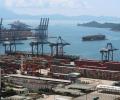
With the Iran war escalating sharply and crisis deepening in the global energy market, India on Monday unveiled a coordinated plan to support exporters and shippers caught in the fallout.

By appearing to privilege ideological affinity over strategic balance, India risks eroding the trust painstakingly built across West Asia. Once the perception takes hold that India's friendship is conditional and transactional, rebuilding credibility will be difficult, warns Amberish K Diwanji.

Let us start with ourselves. If we can reduce our LPG consumption by half, the problem is solved. Reduce wastage. Alter eating styles. Diversify methods of food preparation, suggests Vice Admiral Biswajit Dasgupta (retd).

When everyone has footage and no one can verify it, the loudest voice wins, notes Prem Panicker who begins a daily blog on the War in the Middle East.

What we are watching is something different: A fog manufactured and maintained by the people who started the war, so that the question of why it was started never has to be answered, observes Prem Panicker in his must read blog on the war in the Middle East.
'I suspect that Bangladesh being given permission stuck in India's official craw, and this story was an attempt to balance the scales by giving the impression that a similar waiver had been given to India as well.'

'The background for the Saudi-Pakistan agreement is the fact that the regional security order has collapsed due to the Israeli attack on Doha.' 'The Americans have largely abandoned their security guarantee for West Asia and the region has no choice but to look at alternatives.'

Indian refiners are likely to import 2-2.2 million barrels per day of Russian crude oil in June - the highest in the last two years and more than the total volumes bought from Iraq, Saudi Arabia, the UAE and Kuwait, preliminary data by global trade analytics firm Kpler showed.

India briefed envoys of the US, UK, France, China, Russia, Germany and several other countries on the Pahalgam terror attack and its link to cross-border terrorism. Foreign Secretary Vikram Misri apprised the diplomats about various aspects of the dastardly terror attack on innocent civilians and India's firm policy of "zero tolerance" against terrorism. The briefing was held a day after India announced a raft of measures against Pakistan including expulsion of Pakistani military attaches, suspension of the Indus Water Treaty of 1960 and immediate shutting down of the Attari land-transit post. The Cabinet Committee on Security headed by Prime Minister Narendra Modi firmed up the punitive measures against Pakistan in view of the cross-border links to the Pahalgam attack that killed 26 people. Diplomats of Oman, the United Arab Emirates, Qatar, Norway, Italy, Indonesia and Malaysia were also part of the briefing. Prime Minister Narendra Modi vowed to punish terrorists behind the strike and said India's spirit will never be broken by terrorism.

In the aftermath of the Pahalgam terror attack, which claimed 26 lives and injured many, the government ordered all Pakistani nationals to leave the country and revoked their visas.
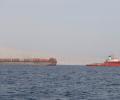
US strikes on Iran's three main nuclear facilities have once again raised concerns that Tehran might shut down the Strait of Hormuz - one of the world's most critical chokepoints, through which a fifth of global oil and gas supply flows.
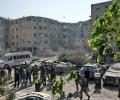
At the end of the day, for many worldwide, the ongoing mutual attacks between Israel and Iran would seem a contest devoid of any moral high ground and only a bout between two ordinary adversaries, one that nevertheless risks spinning out of control into a larger conflagration, notes Shyam G Menon.

US authorities have been scrambling to establish how many Americans have been killed or taken hostage in the conflict.

The MEA said Indian nationals residing in Iraq are advised to be alert and may avoid travel within Iraq. The DGCA asked airlines to take all precautions in airspace over Iran, Iraq, Gulf of Oman and waters of Persian Gulf.

The Indian Navy said warships and aircraft were deployed to establish presence, provide a sense of reassurance to the Indian merchant men
